10.29.2015


From a much longer UPS news release on this year's Peak Season:

UPS expects to deliver more than 630 million packages between Black Friday and New Year’s Eve, an increase of more than 10 percent over holiday deliveries last year. This UPS peak holiday shipping period includes an additional shipping day before Christmas versus 2014.

The company plans to deliver about 36 million packages on Tuesday, Dec. 22, up from 35 million last year, and double the normal daily average of 18 million deliveries. Consumers’ preference for ecommerce, coupled with the industry’s most often selected delivery solutions have driven UPS’s peak volume to all-time highs. The company tallied about 17 million deliveries on its peak delivery day just 10 years ago.

Since Christmas falls on Friday this year UPS plans for high daily residential delivery volume throughout the week. The company expects to make a record number of deliveries to residential addresses during the holiday period, up to 60 percent of all package deliveries, versus an average of 45 percent on a full-year basis


In 2010 Forester predicted US online retail would exceed $250 billion by 2014.  Actual numbers came in at just over $304 billion. In mid-2014 Forrester offered the projections shown above.

10.27.2015

Last-mile can often be "golden". For many products long-haul is a commodity business. In today's (and probably tomorrow's) tight market for trucking, fleet management is fundamental. But there is not much need or pay-off for mass customization. A case can even be made that such a strategy is non-scalable (so far).

But within twenty-or-so miles of a supply node, customization is almost constant. As more products are increasingly delivered direct to consumers, the needs and potential pay-offs of effective -- systematic -- customization will grow.

UPS and Fedex have clearly benefited from this trend. USPS as well. Uber is targeting the potential. Last week Baird Equity Research suggested that Amazon is beginning to probe (then adapt, then accelerate) operations as a direct-delivery provider.

According to Baird's analysis:

Our assessment of Amazon's broadening fulfillment ecosystem, internal domain expertise, and early initiatives with Prime Now to offer third-party delivery suggests there is evidence Amazon may ultimately pursue more comprehensive third-party services. Similar to the gradual rollout of AWS, we would expect Amazon to introduce competitive transportation and logistics services on an incremental basis, with a long-term focus. Ideal customers for ATL (Amazon Transportation & Logistics) would range from SMBs to enterprise businesses that lack financial resources, expertise, or technology horsepower to manage fulfillment/logistics internally, and with an offering that raises the competitive bar vs. incumbent service providers. Amazon currently operates >165 fulfillment centers worldwide, and is already testing “last mile”delivery of products not sold via Amazon’s websites.

10.23.2015


Amazon's stock soared to a new high today on news of modest profits on strong earnings that far outpaced expectations.  Amazon's sales rose 30% over the same period in 2014.

Which was a bit like a poke in the eye for Walmart which one week ago projected profits falling by as much as twelve percent next year as it invests in ecommerce -- especially supply chain enhancement -- and improved customer service.

Thursday the New York Times published a nice comparison/contrast of Walmart and Amazon.  Nothing not already reported by this blog, but a helpful overview.  The shift to online retail is occurring even faster than many predicted.  Amazon's supply chain is optimized for online purchasing and home delivery.  Walmart's supply chain dominated the supercenter age.  Sears commanded telegraph and railways.

10.21.2015


According to the Wall Street Journal:

The biggest landlords in the U.S. are being crushed under a mountain of packages, leading one large apartment operator to stop accepting deliveries and others to experiment with ways to minimize the clutter.

The moves are at the center of two colliding trends: an increase in apartment living and a surge in online shopping. The result is a rising tide of packages with no good place to go.

U.S. online retail sales are expected to swell to $334 billion in 2015, up from $263 billion in 2013, according to Forrester Research Inc., a research and advisory firm. Analysts at Forrester expect that number to increase to $480 billion in 2019.

Just wait until Christmas.

10.19.2015

According to the MIT Sloan Management Review:

...access to transparent, accurate data is a prerequisite for effective supply chain collaboration and coordination. Lack of transparency is often born from a lack of trust or confidentiality issues. But we are already seeing progressive companies developing novel solutions to this dilemma — such as data “cleanrooms” and digital marketplaces. 

 What we call data “cleanrooms,” often managed by a third party, allow the sharing of sensitive data (for example, consumer demand, product cost breakdown, and asset utilization) in a legal and secure data environment that lets participants better identify and size opportunities for joint value creation.

For a few years now many of us have been talking about how there needs to be a kind of Federal Reserve System for supply chains.  It is sometimes forgotten that the Fed is a sophisticated private-public partnerships.  And especially at the regional level, the private sector is arguably predominant.

What the Fed has done to clarify and manage -- and crucially troubleshoot -- the money supply, another private-public partnership could do for other supplies.

10.15.2015

Walmart practically destroyed Sears and transformed the grocery industry by deploying late 20th Century supply chain strategies. It is now competing for the 21st Century strategic high-ground.

On October 14 the Dow Jones Industrials fell over 150 points (and Albertson's held back from its IPO) as Walmart's stock price fell 10 percent and led the retail sector in reporting disappointing results and prospects.  The world's largest retailer has loss 30 percent market value since January.

According to the Wall Street Journal:

For months Wal-Mart executives have subtly made their case that investors should view the company as a growing e-commerce player that happens to be a behemoth. It has asked them to be patient as the retailer, which has half a trillion in annual sales, spends heavily to turn the giant ship around to better compete with Amazon.com Inc. and other faster-growing retailers like Kroger Co. and Costco Wholesale Corp.

Wal-Mart’s “biggest competitor is online and doesn’t care about profits. It’s hard,” said Mr. Yarbrough, referring to Amazon...

Wal-Mart is pitching its stores and massive network of distribution centers as a key strength in its battle with Amazon. In a PowerPoint presentation Wednesday, Mr. McMillon, the CEO, showed investors a slide with pictures of online retailers that have opened brick-and-mortar locations, including Warby Parker and Rent the Runway.

“Here is a key question: Will it be easier for an e-commerce company to build out a massive store network and create a customer-service culture at scale, or are we better able to add digital and supply-chain capabilities and leverage our existing stores?,” he said.


Personal story: Tuesday Amazon did not get me a promised one-day delivery (I am not a Prime member and had paid $60 for the fast service). I complained. Within six minutes I had a seemingly (not really) personalized response and a full refund. I've since received my product. That's a capability that will be very tough to equal. Stand by for a furious fight.

10.12.2015

Yossi Sheffi's new book on supply chain resilience should be read by anyone who has ever glanced at this blog. https://mitpress.mit.edu/books/power-resilience

10.06.2015

On October 1 Walmart opened a new fulfillment center. According to the company, "The 1.2 million sq. ft. facility in Union City, just south of Atlanta, is the third large-scale e-commerce fulfillment center to open in the U.S. in as many months, and features state-of-the-art automation and warehousing systems."

 According to Reuters:

Competition with online rivals including Amazon.com, which recently surpassed it in market value, has heated up and Wal-Mart has committed as much as $1.5 billion this year to invest in e-commerce. Much of that is going into large-scale warehouses dedicated to fulfilling online orders. It now has five such facilities, from which it says it will be able deliver to 95 percent of country in two days. The facilities - some big enough to house two cruise liners - will enable it to receive, sort and ship packages faster and at a lower cost, Michael Bender, chief operating officer of global e-commerce, said in an interview.

Last week Amazon opened a similar-sized new fulfillment center outside Baltimore.  According to The Sun:

The 1 million-square-foot fulfillment center, which the state and city lured to Baltimore two years ago with an incentive package of more than $43 million, started operations March 30, while still under construction. Now tens of thousands of packages ship to customers each day from the building. The firm also opened a smaller sorting center nearby last October. The bigger building, where Amazon now employs more than 3,000 people, is open 24 hours a day, with staff working in staggered 10-hour, four-day-a-week shifts.

Construction companies for distribution and fulfillment centers say that since the turn of the century the average size of new facilities has tripled to just about 900,000 square feet. As Amazon and Walmart demonstrate, plenty are even larger.

10.04.2015


The National Weather Service is forecasting a potentially very strong El Niño Effect for the upcoming Winter and early Spring: "All models surveyed predict El Niño to continue into the Northern Hemisphere spring 2016, and all multi-model averages predict a peak in late fall/early winter."

East Asia and Southern California may experience especially significant effects.  Typhoon Etau's mid-September hit on Japan is seen by many forecasters as a precursor of the potential for extreme outcomes.

A White Paper by one supply chain software firm notes, "The recent flooding from Severe Tropical Storm Etau in Japan is the first significant manifestation of El Niño. It may serve as a wakeup call for CPOs and organizations complacent about the potential El Niño threat to supply chain operations. It is also illustrative of the types of El Niño impacts that organizations can expect and the opportunities for proactive threat mitigation actions moving forward."

Roughly sixty percent of US imports arrive at the Ports of Los Angeles and Long Beach.

10.01.2015


Amazon is recruiting 1099-contract drivers to deliver packages within one-hour in a Seattle test-drive. They call the test AmazonFlex. According to Wired:

Flex fits neatly into Amazon’s ultimate goal to own all retail. Over the years, Amazon has built up a massive logistics infrastructure to make convenient deliveries scalable. It’s poured money into building huge fulfillment centers near major metro areas, which has eaten hugely into the company’s bottom line. Now, owning a platform for on-demand workers on top of all that could help the company hammer out streamlined delivery routes using tracking software.

Motley Fool comments, "Amazon.com is constructing massive warehouses in the outskirts of America's biggest cities that could serve as a durable competitive advantage for generations to come."

According to Wired, Amazon aspires to be the dominant set-of-nodes in US (and beyond) retail.  Meanwhile, retail competition caused by Amazon is producing a proliferation of nodes and innovation.  Is the increased system resilience transient?

9.30.2015


The founder and CEO of Starbucks was a head-liner at this week's Council of Supply Chain Management Professionals (CSCMP) annual conference.

Reflecting on Starbucks' near-death and strong recovery, DCVelocity reports that Howard Schultz told the crowd, "Growth and success covers up mistakes," At Starbucks this included a supply chain that was mostly unknown. It was an ignorance for which they paid dearly.  Only on the edge of failure did the company finally take its supply chain seriously. Schultz now credits supply chain management as the "primary co-author of our business. You cannot scale a company of any kind without the skills and base of a supply chain."

Schultz continued, "Given the fact that the Internet as we know it today is literally the death of distance, and that distance is getting narrower and narrower in terms of the last ten feet, …that is now being linked to delivery, specifically short-term delivery that could be in an hour or 30 minutes. With all these things going on, it won’t be status quo as we know it today."


In my own experience the biggest impediment to improving supply chain resilience is success. The greater the success, the less time, energy, or inclination remains for the self-critique and perspective that informs resilient choices.

9.29.2015


The 2015 annual survey of Third Party Logistics (3pl) is now available.  The Wall Street Journal reports that the survey indicates, "A recent wave of logistics industry mergers and acquisitions is likely to accelerate in the coming year,..The survey found that many chief executive officers of third-party logistics operators, which arrange transportation and logistics services for retailers and manufacturers, expect to see defensive acquisitions growing in the wake of 10 major deals totaling $18 billion signed since early 2014."

9.27.2015


Last Thursday (09/24/2015) Coca-Cola announced, "the formation of a new National Product Supply System (“NPSS”) in the United States. The mission of the NPSS will be to facilitate optimal operation of the U.S. product supply system for Coca-Cola bottlers in order to:
  • Achieve the lowest optimal manufactured and delivered cost for all bottlers in the Coca-Cola system
  • Enable system investment to build sustainable capability and competitive advantage
  • Prioritize quality, service and innovation in order to successfully meet and exceed customer and consumer requirements."
If the action and its purpose still strike you as obscure, don't feel alone.  Bureacracies, public or private, tend to all sound alike.  Maybe that's why the stock price barely budged.


The world's largest soda maker is facing sluggish sales volumes in the U.S.. It has been selling bottling operations, which partly entail getting its products to retailers, to franchisees to shift away from the capital intensive and low-margin business of distribution.

Until now, though, it has not sold production facilities, where its concentrate is combined with other ingredients and bottled up. The sale of the plants, which produce soft drinks like Coke, Sprite and Fanta, is expected to take place between 2016 and 2018, Coca-Cola said.

"By selling production facilities, we expect (Coke) will generate higher return on invested capital as its capital base is reduced, and have incremental cash to reinvest and return to shareholders," said Bonnie Herzog, an analyst at Wells Fargo, in a note


The Wall Street Journal included the following in its report on the deal:

Tom Haynes, an industry consultant and former Coke executive, said he expects the company will sign more deals to divest U.S. manufacturing plants. “Coke’s primary expertise is sales and marketing,’’ said Mr. Haynes, who headed the Coca-Cola Bottlers’ Association from 2002 to 2012.

What I see is another move toward functional disaggregation and strategic concentration.  Supply chains tended to be vertically integrated.  Supply networks tend to be horizontally collaborative.  Each participant in the network seeks to identify and amplify its particular comparative advantage and cooperate with the best-of-class in other areas of functional expertise.

9.25.2015


In August the City of Moreno Valley (CA.) approved development of the World Logistics Center for a site on the eastern edge of the Inland Empire jurisdiction.  According to the city:

Generally, the project site is located east of Redlands Boulevard, south of the SR-60, west of Gilman Springs Road, and north of the San Jacinto Wildlife Area. The proposed World Logistics Center (WLC) project area is approximately 3,818 acres and includes a new 2,610 acre Specific Plan area. The project is envisioned to accommodate up to 40.6 million square feet of high cube industrial warehouse distribution development and related uses. (Map above)

In recent years one of the most significant economic engines for the region East of Los Angeles has been the proliferation of warehousing, product sorting, distribution and other supply chain functions. This new project is the largest yet,

There are several legal actions underway to challenge the project. But as far as I know, no one is questioning the seismic sustainability of the site or the resiliency of its construction. Below is another map showing the site's proximity to the San Andreas fault (the red line 18 miles east).  It is even closer to the San Jacinto Fault.

It is amazing how much we are investing in -- and depending on -- areas that we can be sure will be hit hard, even while giving minimal attention to mitigation.


9.23.2015

MIT is hosting an October 15 Conference on transportation and the Internet-of-Things (IoT)

According to the widely-circulated invitation:

Our transportation system is not meeting the needs of our changing trade and diverse population. Capacity is shrinking just as our demand is growing. How will the Internet of Things address these increasing challenges? The transportation market has responded with new services and technologies, from IoT to telematics, and mobility to RFID and sensors for asset tracking. Trucks, ships, and trains are already loaded with technologies which continue to be enhanced to improve on time, safety, and cost metrics.

More information and an opportunity to register HERE.

9.20.2015

Home Depot has opened its third facility committed entirely to filling online orders.  According to the Toledo Blade:

The first was placed in Georgia near corporate headquarters and the second in California to service the west coast. But the third facility is the largest yet, at 1.6 million square feet.

Northwest Ohio was a perfect fit for what Home Depot was looking for.

"Geographically, this gives us reach to all of our customers zip codes, about 90 percent of the U.S. population within two shipping days." said Scott Spata, Vice President of Home Depot Direct Fulfillment.

This facility is where online orders are sorted and shipped directly to the customers.

While Home Depot stores hold 35,000 items, Online direct services offer one million products to chose from.

9.18.2015

According to the Wall Street Journal:

At its hub in Louisville, Ky., United Parcel Service Inc. recently rolled out 100 industrial-grade 3-D printers to make everything from iPhone gizmos to airplane parts.

UPS wants to find out if 3-D printing centers could shorten supply chains and cut into its $58 billion-a-year transportation business—or give it a leg up in a potentially emerging market for local production and delivery.

For Atlanta-based UPS, the difference could be existential. It doesn’t want 3-D printing to disrupt its business the way the Internet pulled the rug out from overnight document deliveries more than a decade ago. MORE.

9.14.2015


Over the weekend I was talking to a leading transportation specialist who, while drinking at the time, soberly said, "Transportation policy in this nation does not currently exist. There are putative policy notions. There is no extant policy, sustainable funding, or credible vision for policy or funding."

According to The Hill:

Even as they maintain that they want to strike a major deal in the next few months, House Republicans still face a number of obstacles in reaching an agreement with a skeptical Senate before the end of 2015.

Lawmakers currently have an Oct. 29 deadline for extending highway programs, and had been under the impression that the Highway Trust Fund could easily be replenished through mid-December.

If the House is unable to make progress on both its international tax plan and highway policy in the coming months, the chamber could be forced to accept a Senate highway bill passed this summer that House leaders have repeatedly said is riddled with deficiencies. The Senate bill authorizes six years worth of highway policy, but only includes funding for three years.

Already, the House Transportation Committee has had to put off its plans to consider a six-year highway bill, and have not announced a timeline for when it will take up a measure — raising the chances that the House will be unable to pass its own long-term bill and then hash out a compromise with the Senate by the October deadline.


Last month Politico published a special edition on transportation (that I just noticed).  See The Agenda: Transportation.

9.12.2015

This weekend I am trying to get through some accumulated reading, including an August White Paper entitled "Food Industry Logistics: Trends that Matter".  A couple of quotes:

THEN: Logistics networks have been designed with mindsets relevant to a prior era. Production and distribution efficiencies commonly drive product and placement. The infrastructure and apparatus are built around a high proportion of (and preference for) heavily processed foods with extended shelf life. Large manufacturing plants and distribution centers are prevalent, and efficiencies have been built around bulk shipments, which have often driven product assortment decisions. Lastly, outbound distribution models have been designed by large players to maximize their bottom line relying on fairly predictable demand rather than to respond optimally to consumer on-the-go needs.

NOW: Growing consumer expectations for freshness require shorter farm-to-fork times and distances. There has been major growth in small-footprint urban retail locations, as well as substantial growth in home delivery from online channels (e.g., Blue Apron). “Uber-type” on-demand deliveries in a one- to four-hour timeframe have also come to market... There is growth in nontraditional retail and foodservice channels (e.g., limited-assortment and fresh-format stores, specialized chains). Convenience retailers are actively working to deliver a broader, fresher and better variety of prepared foods to customers. Emerging channels like food trucks and farmers markets with unique offerings are also developing; many are harnessing the power of social media to reach consumers.

IMPLICATIONSThis will radically impact food industry logistics.... The increasing need to be closer to customers necessitates additional brick-and-mortar facilities (e.g., distribution centers, cross docks). To speed up cycle time even further, robots, automation and advanced technologies will be required.

I agree this is happening.  I agree it could be important in a whole host of ways including enhanced network resilience.  The proportional impact of these trends is not yet clear to me.

9.07.2015

The September issue of Supermarket News compares mobile options in the Big Apple.  It can be a bit confusing.  Not exactly apples and oranges.  More like comparing priced-by-the-ounce or by the quart or bushel.


9.01.2015


Above is one 2014 effort to map Amazon fulfillment centers

According to the Wall Street Journal:

A Cuisinart warehoused in California may no longer qualify for two-day shipping to a Prime member in Vermont. That’s the idea behind a new program Amazon is testing with some independent merchants.

The program, nicknamed Ship by Region, lets certain sellers designate where they’re willing to ship goods in two days or less to Prime members.

The merchants may limit how far they will ship some items – large-screen televisions, for example – with the two-day guarantee under Prime. If a Prime customer is outside that region, shipping may take longer.


Physics is still a factor. Time can be compressed. Space can be bent. But the energy required is better spent on dense, proximate concentrations.

Did you see, by the way, the Amazon patent application for their particular use of public transit for deliveries? Here it is.

8.31.2015

The California Supply Chain Transparency Act became law in 2010.  Most of the law's requirements became effective on January 1, 2012.

Legislative intent focused on reducing slave labor and human trafficking in supply chains. Companies operating in California with annual revenues of more than $100 million are required to disclose how they (1) engage in verification of product supply chains to evaluate and address risks of human trafficking and slavery; (2) conduct audits of suppliers; (3) require direct supplies to certify that materials incorporated into the product comply with the laws regarding slavery and human trafficking of the countries in which they are doing business; (4) maintain accountability standards and procedures for employees or contractors that fail to meet company standards regarding slavery and human trafficking; and (5) provide employees and management training on slavery and human trafficking.

Earlier this month the first class-action lawsuit was filed under the Act. According to the National Law Review:

The complaint in the new Costco case spends about 40 of its 50 pages alleging that slave labor exists in certain fishing areas of Southeast Asia. About half of those pages are replete with photographs and quotations from multinational media and NGO documentaries and commentaries – about slavery, not about Costco...

And then, in what will be both a theme and an organizing principle in this new sort of litigation, the complaint boldly alleges a short sentence 42 pages into the depiction of a centuries’ old problem that multiple governments and NGOs are combating – that “Costco could remedy this situation by enforcing its supplier standards, which prohibit slave labor and human trafficking.”


Is it a supply chain  where each link is under the control of individually responsible parties?  Or is the supply-and-demand network a commons in which most conceptions of control are either very narrow or delusional?  What is the responsibility of apex consumers in the system? How can any such responsibility be most effectively exercised?

8.28.2015


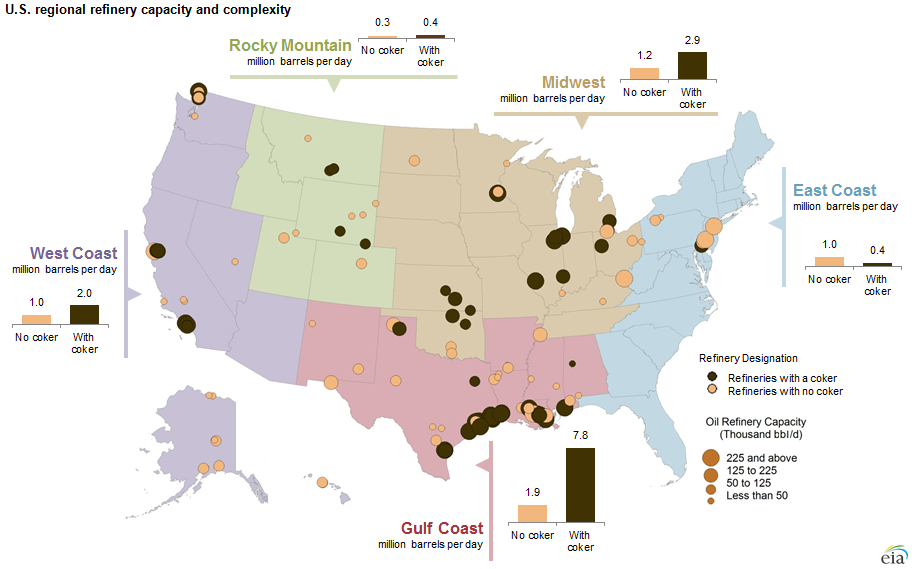
I've been traveling too much, hence the absence of new posts.  But travel teaches.  Last week I landed in Chicago where gasoline was selling at about $3.50 per gallon compared with about $2.35 in Virginia.

The cause was an unexpected maintenance issue at a big BP refinery in Whiting, Indiana.  After two weeks offline, the refinery was close to full capacity this Tuesday and prices are beginning to adjust.

Petroleum prices have recently been at a six year low and prices-at-the-pump across most of the nation reflect abundant supply.  Except where cheap product cannot be processed.

In California a February explosion at an Exxon refinery in Torrance that usually accounts for ten percent of the state's output has continued to suppress availability.  Gasoline prices in LA are even higher than Chicago.

According to the Wall Street Journal:

Supplies also are getting tight along the U.S. East Coast as a large fire broke out at a Delaware City refinery on Friday and operational problems cut into fuel production at plants in New Jersey and Pennsylvania, according analysts.

After running full-tilt for more than a year, American refineries appear to be hitting their limits, said Sandy Fielden, an analyst at energy market researcher RBN Energy LLC.

“Refiners have been running plants hell-for-leather to take advantage of strong margins,” he said. “It stands to reason that if you run any sophisticated plant harder and faster than normal—you are bound to end up breaking something.”


There are 140 refineries -- of various capacities -- in the United States. The map shows their locations (More from EIA). As with most products, availability is a function of production, processing, and transportation.  Interruption at any point reduces actual supply.

8.20.2015

On the cusp of the back-to-school season and well-before the traditional surge for the holidays, trucking volumes popped during July. According to the American Trucking Associations:

The advanced seasonally adjusted For-Hire Truck Tonnage Index increased 2.8% in July, following a revised drop of 0.4% during June. In July, the index equaled 135.0 (2000=100), the second highest level on record. The all-time high of 135.8 was reached in January 2015.

And even as demand for trucking increases, the supply of truckers continues to fall behind. In an August 18 blog post Yossi Sheffi explains why he does not see a near-term solution emerging.

[Additional commentary and links at Homeland Security Watch]

8.18.2015

The Final Project Report from the UK-US Taskforce on Extreme Weather and Global Food System Resilience outlines "urgent" challenges that arise both from shifting weather patterns and from structural characteristics of the global supply chain for food. According to the authors:

We present evidence that the global food system is vulnerable to production shocks caused by extreme weather, and that this risk is growing. Although much more work needs to be done to reduce uncertainty, preliminary analysis of limited existing data suggests that the risk of a 1-in-100 year production shock is likely to increase to 1-in-30 or more by 2040. Additionally, recent studies suggest that our reliance on increasing volumes of global trade, whilst having many benefits, also creates structural vulnerability via a liability to amplify production shocks in some circumstances. Action is therefore needed to improve the resilience of the global food system to weather-related shocks, to mitigate their impact on people. 

 The report is also a helpful example of the struggle to resolve two contentious intellectual angles on the problem. Is greater resilience more likely to emerge from greater redundancy and centralization or greater diversity and decentralization? I would argue for the latter over the former. But certainly these two binaries do not reflect the full range of choice.

8.13.2015


Writing online at Forbes Business, Steve Banker has a great column on "The Next Revolution in Supply Chain Management."  Read the whole piece.

One key aspect that he sees emerging:

Enhanced risk management capabilities in the control tower. Minutes after a major catastrophe or impactful but less severe event occurs, a company should be able to draw a perimeter around an event epicenter and answer the following questions: What suppliers are included inside the perimeter? What components do I source from them? What products do they go in? Which customers will be impacted? What is my revenue at risk?

I agree. I also agree that today "only a few very large companies with advanced supply chain capabilities moving down [this] road."

Using the same tools that Mr. Banker outlines in his piece, some enterprises -- especially those related to water, food, pharmaceuticals, medical goods, and fuel -- are improving their capability to continue operating inside the perimeter. This is even less common, but especially critical.

8.10.2015

On July 31 UPS and Coyote Logistics announced that Big Brown will buy the Chicago-based logistics/technology company for an eye-popping $1.8 billion. On August 5 XPO, another tech-leading logistics firm, saw its stock price plummet by ten percent in one day.  Meanwhile on August 7 Flexport -- a wannabe Uber for ocean freight -- announced a new round of VC funding.

Friday PwC released an overview of Merger and Acquisition activity in transportation and logistics:

Deal activity improved in the T&L sector in 2Q15, as volume and value increased both sequentially and year-over year. Driven by substantial megadeal growth (more than 36 percent compared to 1Q15), average deal value also increased, to $564 million. 2Q15 saw strong megadeal activity (valued at $1 billion or more), with nine deals valued at $23.6 billion, almost 69 percent of deal value for the quarter. 

What all this -- and much more freight-sector volatility -- indicates is the expanding role real-time data access and analysis is having and will continue to have on logistics. Rather than just moving stuff, logistics must increasingly anticipate and coordinate movement.  As much or more choreography as cartage.  Not just logistics, no longer supply chains, but complex adaptive networks of supply and demand.

8.07.2015

Good Eggs, the VC funded farm-to-fridge online purveyor of locally grown foods, is pulling back from New York, Los Angeles, and New Orleans, to concentrate on the San Francisco Bay market-space.

In a blog post, CEO Rob Spiro explains:

What we didn’t fully understand when we started was that we were creating a new category that required a different approach to supply chains, logistics, and commerce – all of the pieces of getting food from local producers to the kitchens of our customers. It was, and is, complicated, way more complicated than we ever anticipated. We have learned so many lessons, many of them learned “the hard way” by making mistakes and seeing the consequences. As soon as we realize a mistake, we need to correct it, learn from it, and proceed onwards in service of our mission. When building a software business, hard lessons are learned in code and quickly corrected; when building a food and logistics business, hard lessons involve people, and partners, and are very hard to correct.

8.06.2015


Mass production has defined economic progress for two centuries. Persistent sourcing, repeatable processes, and large volumes have reduced per unit costs, provided consistent employment, and delivered dependable quantity with minimum quality.

In most grocery stores, mass production still claims the most floor-space: Dry, bottled, and canned goods fill the middle of the store. Frozen foods are prepared and packaged in millions of units . So, sadly, are most tomatoes.  Minimum quality can be... well, minimum.

Precisely because these are commodity products, price and convenience become the crucial competitive attributes.  Home delivery?  "Free" home delivery?  Amazon Prime?  What Sears pioneered and Sam Walton improved, Jeff Bezos is perfecting. 

In response many are shifting to a very different game. Rather than mass production: mass customization.  

Whole Foods  has flipped the floor. Mass produced is restricted to a few narrow aisles, while a peripheral promenade features in-store prepared foods (or in-store finished foods) such as those pictured above.  Demand for prepared food is growing at twice the rate of other groceries. (See: War on Big Food)

This trend obviously has implications beyond food (and profound implications for supply chains). July 1858 is often marked as the beginning of mass produced shoes.  Have you visited NIKEiD?  Or Shoes of Prey?

Soon: Is product curation a form of mass customization?

8.04.2015

MIT professor -- and supply chain consultant -- David Simchi-Levi, is launching a new start-up focused on supply chain analytics.  Many of the capabilities are built around the principles outlined in his most recent book: Operation Rules.

The cloud-based platform at the core of the new enterprise will feature:

• Supply Chain Network Design

• Multi-Echelon Inventory Optimization

• Supply Chain Risk Management (see prior June 28 post)

• Supply Chain Segmentation, a tool to classify and cluster suppliers, customers and more to facilitate predictive analytics.

See more at Opalytics