
10.19.2016
CBRE the global real-estate management company reports a continued decline in availability of US distribution center space in most urban markets. Availability of industrial space across markets tracked by CBRE declined by 20 basis points (BPs) to 8.4 percent in the third quarter from the second, extending the longest stretch of consecutive quarterly declines since CBRE began tracking the figures in 1989.
Reporting on these results, Supply & Demand Executive characterizes the situation as a "supply-chain arms race". Retailers are in an increasingly life-or-death struggle involving, "big-box distribution centers, last-mile facilities nearest population centers or reverse-logistics facilities to handle returns."
“The industrial market is running full-throttle,” said Jeffrey Havsy, CBRE’s chief economist in the Americas. “The pace of demand has been running nearly double that of supply and vacancy continues to decline in big chunks. Demand is being driven by strong growth in e-commerce, a healthy auto industry and some reshoring of certain types of manufacturing.”

10.13.2016
According to the company and several media reports, Walmart will scale-back expansion of its store network and focus more on e-commerce. USA Today reports that Walmart will:
Meanwhile, Amazon is expanding from a few brick-and-mortar bookstores to a network of grocery stores. According to Wired:
Open 130 stores in the 2017 fiscal year ending in February and 55 in the 2018 fiscal year ending in February 2018.
For a company with nearly 4,600 stores nationwide, those projections reflect relatively inconsequential growth. In the 2015 and 2016 fiscal years, the company added 198 and 316 stores, respectively, according to a securities filing.
The planned small-format openings in the U.S. include 70 in 2017 and 20 in 2018, reflecting a sharp decline after opening 161 in 2016.
These stores are onramps to the company’s online grocery service, Amazon Fresh, which delivers stuff to your door. And they’re giant advertisements for Amazon Fresh. But they can also double as distribution centers. They additional outposts in the vast Amazonian distribution network that is slowly stretching across the planet. You need places that can move all the fresh eggs and milk from week to week, and they might as well double as stores. It’s the same logic that keeps your local grocery store open all night long as employees restock the place: if someone is there, they might as well stay open.
Amazon is not the only e-commerce company planning retail real-estate investments.
And Walmart is not the only grocer exploring various strategies to defend market share from Amazon. Over the last year Kroger has used stores in the Indianapolis area to test and refine its ClickList program by which customers can order online and pick-up at stores. The program is now being rolled out beyond the test-market (and here). Online competition for grocery buying is likely to intensify, even while some warn that technology and marketing may be getting too far ahead of customer demand.
The battle between Walmart and Amazon promises to set consumer expectations and, one way or another, shape how we shop for groceries in 2026.
[Excellent extended piece on the Walmart online grocery strategy from the Washington Post. Related piece from the Wall Street Journal.]
And Walmart is not the only grocer exploring various strategies to defend market share from Amazon. Over the last year Kroger has used stores in the Indianapolis area to test and refine its ClickList program by which customers can order online and pick-up at stores. The program is now being rolled out beyond the test-market (and here). Online competition for grocery buying is likely to intensify, even while some warn that technology and marketing may be getting too far ahead of customer demand.
The battle between Walmart and Amazon promises to set consumer expectations and, one way or another, shape how we shop for groceries in 2026.
[Excellent extended piece on the Walmart online grocery strategy from the Washington Post. Related piece from the Wall Street Journal.]
10.08.2016

Matthew is now a Cat-2 storm with sustained winds in the 30s and on-shore gusts into the 70s. Several storm surge records have been re-set north of Jacksonville.
There is still cause for serious concern depending on how riverine flooding and storm surge interacts with the urban network around Charleston and North Charleston later today. (See impact projections below. This includes intertidal effects. Updates from NOAA at NOWcoast.) Damage to the electrical distribution grid is widespread and will require significant time to restore.
Looking at the results in Haiti and Cuba, it is clear Matthew could have been much worse. A few degrees more turn Northwest with a a high-power direct hit on Miami and this could have been one of the most consequential hurricanes in history. But in terms of supply chain resilience, the effects on the US southeast are quickly recoverable disruptions.

According to CCJ:
Load transactions on DAT’s board show a surge in rates is already underway, particularly into and out of the Raleigh area, which is situated close to the intersection of I-95 and I-40. “It looks like the flooding is making it harder to find an available truck in the markets just south of Raleigh,” said a DAT analyst. “So far this week, most of the loads posted on the load board that are bound for Raleigh are coming from Atlanta, and the Atlanta to Raleigh lane is up 18 cents in the past seven days.”
Truckstop.com, another load board tracking post-Matthew rates, said rates in storm-impacted states jumped last week ahead of the storm. Truckstop.com’s Roxanne Bullard said rates jumped “dramatically” last weekend, but have since fallen below the rolling 30-day average. “It will be interesting to see once all interstates open back up if that will change,” she said.At least twenty have died in North Carolina as a result of flooding. The situation in Haiti is beyond description.
10.07.2016

Estimated customers without power in Florida counties served by Florida Power and Light about 6PM Eastern on Friday, October 7. Information provided by FP&L and USA Today.

 As I write this Hurricane Matthew has just begun to move up Florida's Atlantic coast. The map on the right shows projected wind speeds. Purple indicates 100 percent probability of wind speeds above 40 miles per hour. Gusts up to 107 MPH have been reported at several on-shore locations.
The left-side map shows grocery distribution centers for roughly 80 percent of the market in Central to South Florida and about 60-70 percent of North Florida. I-95 is the obvious major link between supply and demand. The road network is sparse in the middle of the peninsula.
The hurricane just missed Miami and Ft. Lauderdale. As a result, supply capacity in Metro Miami will continue to be available post-disaster. There are also significant sources of capacity in the Tampa/Lakeland corridor that should experience minimal disruption.

A Category 4 or worse storm shearing up the I-95 corridor from Miami to Jacksonville has long been a nightmare scenario. Matthew has been a Cat-3 that began its roll north of the densest population concentration. Moreover, so far the eyewall and has remained just enough off-shore to spare the coast the worst winds.
A 7-to-11 foot storm surge is currently forecast for Sebastian Inlet, Florida, to the Edisto Beach, South Carolina between Friday night and late Saturday.
Not a worst case (yet), but plenty bad.
9.29.2016

Excellent piece of reporting in yesterday's Wall Street Journal. But I disagree with this take-away:
Amazon’s goal, these people say, is to one day haul and deliver packages for itself as well as other retailers and consumers—potentially upending the traditional relationship between seller and sender.
Some executives refer to the initiative as “Consume the City,” a nod to the company’s plans to build a massive delivery network that could eventually compete with such partners as UPS, according to people familiar the matter.What is suggested in the WSJ piece -- and baldly asserted elsewhere -- is that Amazon is intent on taking down UPS and FedEx.
This is a 1970s notion of survival of the fittest and winner-take-all capitalist competition.
With more time than I have this morning, I would argue that what is going on is innovative problem-solving, gap filling, exploration, and adaptation within a rapidly evolving transformation of retail... and all its supportive systems.
Everyday across the planet in every sector I know anything about there is an extraordinary range of coopetition...cooperation, collaboration, joint venturing, and more between intense competitors. This is especially true in supply chain.
9.26.2016

I'm in Memphis. Today I visited a replica of the original 1916 Piggly Wiggly store hosted by the Pink Palace Museum (shown above). This is arguably the earliest commercially successful implementation of supply chain pull and the precursor of Just-in-Time.
I had studied the original diagrams and patent for the store, but I had not noticed before how thin Clarence Saunders had designed and built his shelves. Each shelf has sufficient depth for one large can-good, which further emphasizes how each purchase would send an urgent signal up the chain -- and it was a chain back then -- regarding customer choice.
In 1956 Taiichi Ohno, a Toyota engineer, visited a Piggly Wiggly and was inspired to reconfigure how automobiles were manufactured.
Ohno perceived that as pull signals travel toward sources of supply they can facilitate a tight focus on what is being consumed: what is really needed. This can – if recognized – be used to eliminate waste and costs related to Just-in-Case hoarding of resources and over-production.
Organizing production to reflect consumer “pull”, rather than the “push” of historical patterns or guesses about the future was a revolutionary shift. Especially when the signals are treated as measures and the measures are consistently applied to manage production (and distribution and more), a very different relationship emerges between sources of demand and sources of supply.
9.17.2016

AL.com is doing a good job updating the repair process.
To stop the leak and repair the pipe, fuel transport has been discontinued in Colonial Pipeline 1. Some product adjustments are being made to a parallel pipeline to mitigate supply disruptions. On a typical day Colonial delivers about 2.6 million gallons of refined product. It is the principal source of refined products along its route between Houston and Baltimore. It is an important, but secondary source in markets between Baltimore and New York City.
On Saturday, September 17 the Atlanta Journal Constitution reports, "Drivers in metro Atlanta and throughout the state faced long lines and dry pumps Saturday as fallout from an Alabama pipeline spill threatened gasoline supplies in Georgia." Substantial shortages are also being reported in the Nashville region.
Loss or prospective loss of supply has prompted the Governors of Tennessee, Alabama, Georgia, South Carolina, and Virginia to declare state emergencies or take similar action. In Georgia an executive order has suspended regulations limiting operator hours for commercial vehicles delivering transportation fuel. This is a common feature of actions being taken in the other states. (In many cases, major tanker companies will continue to comply with hour regulations even when waivers are provided to avoid the risk of negligence charges in case of accidents.)
Reuters reports some non-pipeline alternatives for fuel transport are springing up. But if the pipeline is repaired and transport begins early during the week of September 18, as expected, wide-spread shortages should be avoided north of Richmond, Virginia and may stay south of Charlotte [September 19 update: some serious shortages are emerging in the Charlotte metro area. Much earlier than I expected. Wish I had said Greensboro. But at this rate, even Richmond and north is not yet out of trouble]. Prices have already increased slightly in affected markets reflecting reduced supply.
September 20 Update: Today there will be widespread shortages in the Triangle market. Hoarding is definitely accelerating the problem. There are a few reports of stations going dry in Southern Virginia. Once one or two fail, hoarding will quickly bring down others.
Here's a comment to make you stand up straight:
September 21 Update: According to Reuters federal approval has been given for the bypass line to be used to restart pipeline operations.
September 20 Update: Today there will be widespread shortages in the Triangle market. Hoarding is definitely accelerating the problem. There are a few reports of stations going dry in Southern Virginia. Once one or two fail, hoarding will quickly bring down others.
Here's a comment to make you stand up straight:
Petroleum Transport Terminal Manager Tommy Lowe says currently Greensboro's tank farm is virtually empty.
"We're looking at a week to 10 days before the product will actually get here. They've got to get it in, settled out, and then they'll turn it loose," said Lowe. "It's going to take a period of time when the product gets here to get the tank levels back up. We're looking at roughly two weeks to get things back to normal."On Tuesday morning, September 20, Colonial announced:
Construction, fabrication and positioning of the bypass segment around the leak site is complete. Colonial is in the process of executing a hydrostatic test of the segment, which is approximately 500 feet in length, to ensure its structural integrity.They hope to have flow restarted on Wednesday.
September 21 Update: According to Reuters federal approval has been given for the bypass line to be used to restart pipeline operations.
September 22 Update: Flow has resumed. Nice wrap-up piece in AJC. Lots of opportunities here for lessons-learned. We often say that supply chains are socio-technical systems. In this case I perceive a close-call could have been mitigated by earlier technical measures targeting secondary-tertiary network effects and much more attention to the social dynamics behind hoarding.
RUNNING UPDATE: ABC News has aggregated an Associated Press "ticker" on the pipeline disruption here. (not updated since September 19)
RUNNING UPDATE: ABC News has aggregated an Associated Press "ticker" on the pipeline disruption here. (not updated since September 19)
+++
When the Tennessee Governor's executive order was released it was accompanied by the following verbiage:
Tennessee’s price gouging laws make it unlawful for individuals and businesses to charge unreasonable prices for essential goods and services including gasoline, food, ice, fuel, generators, lodging, storage space, and other necessities in direct response to a disaster regardless of whether that emergency occurred in Tennessee or elsewhere. The price gouging law makes it unlawful to charge a price that is grossly in excess of the price charged prior to the emergency. This price gouging act is triggered when a disaster is declared by the state or by the federal government. Penalties for violations of the price gouging act are up to $1,000 per violation. Additionally, the Tennessee Attorney General in conjunction with TDCI’s Division of Consumer Affairs can request that a court issue injunctions and order civil penalties of up to $1,000 for each violation. The state can also seek refunds for consumers.
What is the substantive difference between a meaningful market signal and price gouging?
According to GasBuddy on Sunday morning, September 18 the average price of regular gasoline in metro Atlanta is $2.412 per gallon. Last Sunday the average price was $2.163. Over the same period the national average price has increased from $2.178 to $2.204... even as supplies totally drain away across Alabama and Georgia. No price gouging here.
Does the two-cent differential reflect reality? Certainly not in the short-term. Did it communicate to consumers their emerging risk? Does the two-cent differential incentivize significant changes in demand or supply behavior? Given current demand for gasoline tanker or maritime assets this is far less than needed to make it worthwhile to redirect current operations. Other than working to fix the break, the system is basically waiting for the return of the status quo ante. Hence absence of substantial retail supply in metro Atlanta... even with a week's warning.
Since product may be moving again in the next few days, maybe this is acceptable. In many other contexts I can imagine this passivity -- even denial of reality -- as serving to make a bad situation worse and worse.
Some thinking-out-loud regarding hoarding [September 20 morning]: Some claim that despite the loss of product -- more than half of typical flows in specific Southeast markets -- there is still enough supply to meet "typical" demand. But demand is quickly becoming atypical.
As individual gas stations (demand nodes) go dry, consumers see this as a threat-signal and adjust behavior. One widespread adjustment is frequent topping-off. While the consumer might typically wait until they have a quarter-tank of fuel, they begin to fill up whenever they approach three-quarters full.
This behavior has at least two dramatic impacts on the fuel supply chain: First, it produces entirely new patterns of pull signals. Most consumers typically fill up on a predictable schedule and even at a predictable place, this explosion of randomness undermines system stability. Second, this behavior increases overall demand at precisely the time that supply is fragile. The combination of increased demand and unpredictability of demand produces more dry pumps which, of course, further accelerates consumer hoarding.
In the particular case of Colonial Pipeline we may -- too early to be sure, but worth flagging -- be seeing a situation where a few market leading demand nodes (e.g. QuikTrip in Charlotte, Sheetz in other locations) are especially vulnerable because of their particular dependence on Colonial. As consumers see these market-leading sources go down, they shift to other secondary sources and begin to disrupt fuel supply chains that are not directly dependent on Colonial, but are now disrupted by unpredictable and unsustainable consumer behavior.
Thus over time and space, disruption of the fuel network begins to behave less like a fixable break in an engineered system and more like an ecology ingesting a contagion.
+++
Some thinking-out-loud regarding hoarding [September 20 morning]: Some claim that despite the loss of product -- more than half of typical flows in specific Southeast markets -- there is still enough supply to meet "typical" demand. But demand is quickly becoming atypical.
As individual gas stations (demand nodes) go dry, consumers see this as a threat-signal and adjust behavior. One widespread adjustment is frequent topping-off. While the consumer might typically wait until they have a quarter-tank of fuel, they begin to fill up whenever they approach three-quarters full.
This behavior has at least two dramatic impacts on the fuel supply chain: First, it produces entirely new patterns of pull signals. Most consumers typically fill up on a predictable schedule and even at a predictable place, this explosion of randomness undermines system stability. Second, this behavior increases overall demand at precisely the time that supply is fragile. The combination of increased demand and unpredictability of demand produces more dry pumps which, of course, further accelerates consumer hoarding.
In the particular case of Colonial Pipeline we may -- too early to be sure, but worth flagging -- be seeing a situation where a few market leading demand nodes (e.g. QuikTrip in Charlotte, Sheetz in other locations) are especially vulnerable because of their particular dependence on Colonial. As consumers see these market-leading sources go down, they shift to other secondary sources and begin to disrupt fuel supply chains that are not directly dependent on Colonial, but are now disrupted by unpredictable and unsustainable consumer behavior.
Thus over time and space, disruption of the fuel network begins to behave less like a fixable break in an engineered system and more like an ecology ingesting a contagion.
9.16.2016
Nice Hanjin update from Bloomberg with hard numbers regarding number of vessels and cargo value. It includes this provocative quote by Gerry Wang, CEO of Seaspan, a container-ship leasing company.
“The fallout of Hanjin Shipping is like Lehman Brothers to the financial markets,” Wang said. “It’s a huge, huge nuclear bomb. It shakes up the supply chain, the cornerstone of globalization.”So, there's at least one vote for profound network effects.
9.14.2016

Since at least 1999 Apple has attempted to implement a dual-sourcing strategy for critical product components. This is arguably easier for a market-leading innovator than a price-sensitive market follower. But it has still been tough. It requires a very disciplined approach to product design, specification, sourcing/procurement, and supply chain management.
According to Timothy Arcuri, an analyst at Cowen & Co. a recent deal between Apple and Intel means the iPhone 7 is fully dual sourced. Mr. Arcuri told the Wall Street Journal, he "expects Intel to supply about half of the baseband chips for iPhone 7 units Apple will sell, or around 40 million by the end of 2016." The other half will be supplied by Qualcomm.
Dual sourcing is fundamental to supply chain resilience. With effective strategic execution it can also generate price advantages.
9.13.2016
Very interesting report from the Wall Street Journal. It looks at consumer expectations, costs, and economic sustainability of ecommerce delivery to non-dense areas. An excerpt:
While e-commerce is great for rural America, it is expensive for retailers and delivery companies.
The longest mail route in the country—a 187.6-mile daily loop for carrier Jim Ed Bull—runs from Mangum. The longer the drive and the fewer the packages per stop—known as delivery density—the lower the profit for the U.S. Postal Service, UPS and FedEx.
UPS says one mile a day across its U.S. delivery fleet costs up to $50 million a year. UPS’s Mr. Bledsoe drives 56 miles nearly every day to deliver medicine to one customer—a veterinarian—on his route.
To offset the cost, UPS and FedEx charge an extra $4 per package for remote residential deliveries. The prevalence of free shipping to consumers and the need to price items the same online and in stores, typically leaves retailers bearing this additional cost.
For retailers, that adds to already steep costs. Shipping a container of Tide Pods laundry detergent from Atlanta to urban Oklahoma City is estimated to cost a retailer $11.44—already more than the approximately $11 price of the item itself, according to an analysis by Spend Management Experts. Shipping the pods to Mangum costs $15.65.
9.11.2016
I am the son and grandson of grocers. Thus is the origin of my interest in demand and supply networks and most -- of any -- expertise. I am a generalist in terms of how networks respond to duress and disruption. But when it comes to groceries, I hope to to apply a bit more depth of understanding.
Given this context, I especially appreciate the new piece of public art erected on the Southeast Corner of Central Park (shown below).

According to the Public Art Fund:
MEMORIAL, by British artist David Shrigley (b. 1968, Macclesfield, UK), honors one of the most common of all acts: the writing of a grocery list. By engraving this ephemeral, throwaway list on a solid slab of granite, a material ubiquitous with the language of monuments, the artist humorously subverts both a daily routine and the role of the classic memorial. While Shrigley’s shopping list might appear to posture as a counter monument, through its celebration of a common activity, its anonymity, and absurdity, the sculpture becomes a memorial both to no-one and to everyone—perhaps standing as a simple but poignant ode to humanity.
Given this context, I especially appreciate the new piece of public art erected on the Southeast Corner of Central Park (shown below).

According to the Public Art Fund:
MEMORIAL, by British artist David Shrigley (b. 1968, Macclesfield, UK), honors one of the most common of all acts: the writing of a grocery list. By engraving this ephemeral, throwaway list on a solid slab of granite, a material ubiquitous with the language of monuments, the artist humorously subverts both a daily routine and the role of the classic memorial. While Shrigley’s shopping list might appear to posture as a counter monument, through its celebration of a common activity, its anonymity, and absurdity, the sculpture becomes a memorial both to no-one and to everyone—perhaps standing as a simple but poignant ode to humanity.
It also strikes me as a meaningful reminder of how our greatest cities depend on the most quotidian of inputs.
The art will continue on view until February 12, 2017
9.10.2016
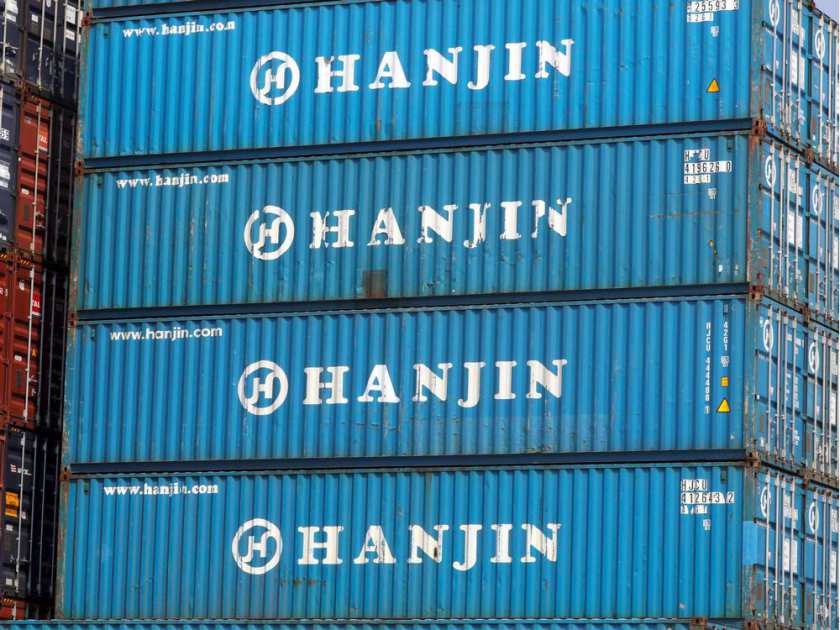
The implosion of Hanjin Shipping Company has disturbed, distracted, and discombobulated me. Several recent events, in fact, have had a similar impact. In the case of Hanjin, I have been trying to determine if this is profound network-effect or "just" old-fashioned bad management: the crucial grain of sand in a catastrophic landslide or just a healthy punctuation?
But while I have been struggling over the evidence, my indecision (among other factors) has kept me from posting on other topics. So here's a collection of some coverage of the Hanjin collapse. I will come back to analysis when my mind -- and maybe the situation -- is clearer.
Hanjin Shipping gets U.S. court order, cash to unload ships
9.06.2016
This is a catch-up post that I missed while pre-occupied with Hanjin. The Economist's cover story in the first week of September focused on Uber. As the magazine does so well, this particular case is placed in strategic context:
Investors’ bullishness is bolstered by Uber’s position at the intersection of three linked disruptive trends. First is the emergence of asset-light business models. The cost of expanding is far lower for a startup that does not own its own cars or consider its drivers employees. Second is the shift to the sharing economy, which underlies the success of peer-to-peer services; a system that lets people do as much or as little as they like attracts workers. The third is that consumers, especially young consumers, are increasingly happy to pay for access to things, rather than own them outright.The piece is, however, entirely focused on the customer-facing opportunity. The uberization of 3PL is worth more attention. Here's one take on this issue.
8.20.2016
Donny Rouse walking through his company's Denham Springs supermarket after this week's historic flooding in South Louisiana. Rouses Market is supplied by Associated Wholesale Grocers, mostly out of its Pearl River LA facility (north of New Orleans, near Slidell). Rouse told The Shelby Report that they hope to have the store re-opened for business in eight to twelve weeks.


Seventy-eight miles of Interstate 10 remained closed Monday afternoon (Aug. 15) because of historic flooding in south Louisiana. The state Department of Transportation and Development said all eastbound and westbound lanes were closed along a 67-mile stretch between U.S. 165 at Iowa and Interstate 49 at Lafayette, as well as on an 11-mile section between Siegen Lane in Baton Rouge and Louisiana 73 at Dutchtown.
I-10 is a major coast-to-coast highway, carrying as many as 55,000 vehicles on the average day on the longer of the two closed stretches, according to state traffic counts. The closed section nearer Baton Rouge averages 117,000 vehicles per day. For long-distance motorists, the nearest east-west interstate highway is I-20 in north Louisiana -- 200 miles away.
Flood waters also caused the closure of eastbound Interstate 12 between Airline Highway in Baton Rouge and Juban Road near Denham Springs. Westbound I-12 was closed between Airline Highway and Interstate 55 at Hammond.
More than 280 highways were closed around the state.Associated Grocers, C&S Wholesale Grocers, and AWG all have major distribution centers along Interstate-12. All are located in parishes encompassed by the federal disaster declaration. According to the Washington Post:
“I’d imagine that at least half of our employees were affected in some way. We have many of them that have basically lost everything,” said Emile Breaux, President and CEO of Associated Grocers, a major food wholesaler in Louisiana.
Breaux had employees coming to work the day after their houses were destroyed with just the clothes on their back. They were ready to work — both for the paycheck but also because they needed to work to help the community start picking up the pieces.
For his part, Breaux said he and anyone else who didn’t flood went home and pulled everything they could out of their closets, “and started our own little garage sale of sorts in one of our conference rooms.”
“We started renting hotel rooms,” he said, “getting them personal care and personal hygiene items.” They also started serving meals to employees and their families. The breakroom, still with air-conditioning and cable TV, began to fill with the sounds of camaraderie.According to the Baton Rouge Business Report:
At LeBlanc’s Frais Marché, an independent supermarket supplied by AG, owner Randy LeBlanc says the lack of personnel has been his biggest challenge by far. He estimates about 50% of his employees are out, either victims of the flood or helping family members who are.
Similarly, at Calvin’s Bocage Market, at least 20 employees were unable to come to work today. Owner Calvin Lindsly was restocking shelves, while his family members were working the checkout lines.
So far, supermarkets that are in operation are managing to keep up with demand for many items, though not all. Water is in short supply, as are bread and chips. LeBlanc says AG has done a much better job restocking his store than have the national vendors. Also running low are paper products and cleaning supplies.
“It’s a little unusual to be running low on dry goods but maybe people know they might not be able to get back out for a while,” LeBlanc says. “Plus a lot of dishwashers aren’t working so paper plates and paper cups are going fast.”Making a very bad situation even worse, the Baton Rouge Food Bank's 170,000 square foot warehouse was essentially taken out by four-feet of flooding.
8.16.2016

This is one of several emerging tools to track and report demand nodes in disasters. Similar efforts have been undertaken for fuel stations and grocery stores.
Healthcare Ready is a program of the pharmacy industry to strengthen healthcare supply chains through collaboration with public health and private sectors by addressing pressing issues before, during, and after disasters.
8.12.2016
Good piece by Farhad Manjoo in the New York Times. He and I basically agree that Amazon is unlikely to reduce use of UPS and other third-party logistics providers... even as it increases internal delivery capacity. Based on recent discussions and research, Manjoo concludes that drones are a fundamental piece of Amazon's long-term strategy. Drones may be the only way for Amazon to continue meeting customer expectations as other transportation avenues approach gridlock. Manjoo makes an interesting case that drones are one way to do an end-run on the realities set out by the Department of Transportation's report Beyond Traffic 2045. One quick quote: "...if we don’t change, in 2045, the transportation system that powered
our rise as a nation will instead slow us down. Transit systems will be so backed up that riders will
wonder not just when they will get to work, but if they will get there at all. At the airports, and on
the highway, every day will be like Thanksgiving is today."
8.11.2016

According to Bloomberg, the National Counter-Intelligence and Security Center is launching a new effort focused on the intersection of cyber-threats and supply chain vulnerabilities.
U.S. intelligence officials are planning to provide information including classified threat reports to companies about the risks of hacking and other crimes tied to the supplies and services they buy... The program will be targeted toward U.S. telecommunications, energy and financial businesses, so government threat reports may soon be offered to companies such as Verizon Communications Inc., Duke Energy Corp. and Bank of America Corp.Several years ago -- well before all the well-publicized corporate hack-attacks -- the supply chain lead for a huge player in the health care sector told me that what he feared most was an intrusion that did not take down his systems, but corrupted data exchange. Plans were in place for total failure. But maliciously manipulating the system could have much more insidious results and seriously complicate recovery.
Some details are available from the NCSC here and here. The FBI also has some recommendations here (PDF).
It is also worth mentioning: About four years ago another member of the US intelligence community -- NOT NCSC -- assigned a team to assess risks to the global supply chain with a particular focus on US economic security. I was one of several private sector folks who received their first brief. We were then divided into small groups of five or six to talk through suggestions.
As soon as the door closed to the conference room for my small group the guy from US Steel started laughing, joined enthusiastically by the guy from Boeing. The rest of us merely smiled or shook our heads. "What a joke," one of us finally said. "I know undergraduate interns that have a better handle on supply chain risk."
Supply and demand networks are complex adaptive systems. This is not a reality easy to understand, much less defend. While we can welcome the help, we should not assume quick sophistication.
8.10.2016
With the Walmart-Jet.com deal decided (if not yet sealed), some thoughts on what could happen and the implications for supply chains.
I am still not convinced this is the right acquisition to spur Walmart's ecommerce ambitions. But with the purchase Walmart picks up at least three important assets:
1. Marc Lore the founder of Jet.com is a successful ecommerce strategist and start-up leader. No one has a better handle on what works. No one is more innovative or prudently risk-taking in developing new ecommerce tactics and techniques. He has a good handle on technology, supply chain, and finance. He has gathered a good team.
2. Jet.com has an online tool that (in my words) gives consumers the ability to optimize their pull-signals around the current strengths of the supply network. So, for example, the more proximate the consumer to a Point-of-Distribution, the less costly the item. The more products that can be shipped in a single delivery, the lower the total price. Voluntarily forsaking free-returns saves more money. You see the logic. I have not seen data that totally convinces me that this software is generating more sustainable "pull". But I'm guessing (hoping) Walmart has seen enough to be confident of future implications. I agree with the logic. (Here's how the Associated Press described the tool: "Jet.com is built on a real-time pricing algorithm that determines which sellers are the most efficient in value and shipping and adjusts prices based on what items are in the checkout cart, as well as how far the desired products are from the shopper's home. So as shoppers throw items in their cart, they're encouraged to add more to build a more efficient cart and buy items labeled "smart cart" for more savings." You can also read Jet's own explanation.)
3. Jet.com allegedly has grown quickly among younger, affluent, urban audiences. Media reports suggest that about 350,000 new customers per month have recently been accessing Jet.com. As a privately-held start-up we don't know much for sure, but -- again -- I'm guessing there was enough of a beachhead among a set of consumers Walmart does not usually engage that the value proposition made sense in Bentonville.
There are other assets. But are these big three worth roughly $1.1 billion each?
It depends on what happens next. From a branding and merchandising perspective Jet.com will probably do better the more it is separated from Walmart. Yet from a supply chain perspective -- and especially from procurement and last mile fulfillment angles -- this connection with the world's largest retailer could be very helpful.
Amazon's Prime program could be characterized as preserving the magic of the supply chain. After you pay the annual subscription, products magically appear. The customer can be delighted by a Sunday afternoon delivery that cost "nothing." Profound bliss.
Jet.com's "real time savings" program involves the customer in making choices to match need-and-capability, earning savings as products and delivery options are selected. Instead of magic, rewards for virtue, restraint, and intelligence. Deeply satisfying.
In today's world there may be substantial markets -- not just micro-markets -- for both kinds of consumer experience.
I am still not convinced this is the right acquisition to spur Walmart's ecommerce ambitions. But with the purchase Walmart picks up at least three important assets:
1. Marc Lore the founder of Jet.com is a successful ecommerce strategist and start-up leader. No one has a better handle on what works. No one is more innovative or prudently risk-taking in developing new ecommerce tactics and techniques. He has a good handle on technology, supply chain, and finance. He has gathered a good team.
2. Jet.com has an online tool that (in my words) gives consumers the ability to optimize their pull-signals around the current strengths of the supply network. So, for example, the more proximate the consumer to a Point-of-Distribution, the less costly the item. The more products that can be shipped in a single delivery, the lower the total price. Voluntarily forsaking free-returns saves more money. You see the logic. I have not seen data that totally convinces me that this software is generating more sustainable "pull". But I'm guessing (hoping) Walmart has seen enough to be confident of future implications. I agree with the logic. (Here's how the Associated Press described the tool: "Jet.com is built on a real-time pricing algorithm that determines which sellers are the most efficient in value and shipping and adjusts prices based on what items are in the checkout cart, as well as how far the desired products are from the shopper's home. So as shoppers throw items in their cart, they're encouraged to add more to build a more efficient cart and buy items labeled "smart cart" for more savings." You can also read Jet's own explanation.)
3. Jet.com allegedly has grown quickly among younger, affluent, urban audiences. Media reports suggest that about 350,000 new customers per month have recently been accessing Jet.com. As a privately-held start-up we don't know much for sure, but -- again -- I'm guessing there was enough of a beachhead among a set of consumers Walmart does not usually engage that the value proposition made sense in Bentonville.
There are other assets. But are these big three worth roughly $1.1 billion each?
It depends on what happens next. From a branding and merchandising perspective Jet.com will probably do better the more it is separated from Walmart. Yet from a supply chain perspective -- and especially from procurement and last mile fulfillment angles -- this connection with the world's largest retailer could be very helpful.
Amazon's Prime program could be characterized as preserving the magic of the supply chain. After you pay the annual subscription, products magically appear. The customer can be delighted by a Sunday afternoon delivery that cost "nothing." Profound bliss.
Jet.com's "real time savings" program involves the customer in making choices to match need-and-capability, earning savings as products and delivery options are selected. Instead of magic, rewards for virtue, restraint, and intelligence. Deeply satisfying.
In today's world there may be substantial markets -- not just micro-markets -- for both kinds of consumer experience.
RMS -- once upon Risk Management Solutions -- has identified ten high-risk maritime ports identifying those it claims are most at risk for the greatest insured loss.
That the Ports of Los Angeles and Long Beach are NOT on the list is both a bit surprising and good news.
PORTS AT RISK FOR HIGHEST LOSSES(500 year estimated catastrophe loss for earthquake, wind, and storm surge perils)
* Losses rounded to one decimal place
Estimated Marine Cargo Loss in Billions USD* 1 Nagoya, Japan 2.3 2 Guangzhou, China 2.0 3 Plaquemines, LA, U.S. 1.5 4 Bremerhaven, Germany 1.0 5 New Orleans, LA, U.S. 1.0 6 Pascagoula, MS, U.S. 1.0 7 Beaumont, TX, U.S. 0.9 8 Baton Rouge, LA, U.S. 0.8 9 Houston, TX, U.S. 0.8 10 Le Havre, France 0.7
8.09.2016
Last weekend a colleague passed along a report from May that I had missed.
Delivering in a Moving World: Looking to our supply chains to meet the increasing scale, cost and complexity of humanitarian needs was developed by Sara Guerrero-Garcia (Kuehne Logistics University), Jean-Baptiste Lamarche (ACF), Rebecca Vince (Plan International), Stephen Cahill (WFP) and Maria Besiou (Kuehne Logistics University).
According to the report, sixty to eighty percent of humanitarian response budgets are consumed by supply chain costs. How to ensure both efficiency and effectiveness of supply chains is obviously a fundamental issue. The authors have attempted to frame the issue around sometimes neglected ground truths.
A couple of long quotes from the report on the role of private supply chains in civic and public crisis response:
All good. All helpful. And it is worth some further attention to differences between private, civic, and public sectors in terms of purposes, worldview, command-and-control, and alternative attitudes toward different facets of risk.
For example, what is a meaningful operational definition of "integrated partnerships" as used above? Given the differences between sectors is this a realistic goal? Might "agile" or "adaptive" or even "pre-planned" partnerships be more realistic?
Delivering in a Moving World: Looking to our supply chains to meet the increasing scale, cost and complexity of humanitarian needs was developed by Sara Guerrero-Garcia (Kuehne Logistics University), Jean-Baptiste Lamarche (ACF), Rebecca Vince (Plan International), Stephen Cahill (WFP) and Maria Besiou (Kuehne Logistics University).
According to the report, sixty to eighty percent of humanitarian response budgets are consumed by supply chain costs. How to ensure both efficiency and effectiveness of supply chains is obviously a fundamental issue. The authors have attempted to frame the issue around sometimes neglected ground truths.
A couple of long quotes from the report on the role of private supply chains in civic and public crisis response:
The humanitarian sector should leverage both sectors’ capacities by establishing long-term collaborations with the private sector that recognises the role of the private sector as an enabler of humanitarian work at local, regional and international levels. This collaboration can be improved by establishing integrated partnerships based on cross-functional planning as a better reaction to a crisis can be ensured by having the private sector involved in the preparedness phase. These integrated partnerships could manifest in pre-agreements on virtual stocks, priority access to production information, stockpiles and service capacity, for instance in future health pandemics. They may also include the development of virtual supply chains, innovative technological tools to improve the accuracy of the demand forecast and the establishment of local partnerships. In order to meet large scale response needs, in particular pandemic health crises, we will also need to improve the management of upstream supply chains which will call for a better coordination, transparency and integrated data sharing.Later in the document is this recommendation:
Strengthening Local Networks: The paper also touches on the challenges ahead to maintain and improve coordination and collaboration in an increasingly populous and complex aid community. As well as the recommendations made above, there is a need to further expand multi-sector local logistics networks, which would bring together the private, public, local civil society and other logistics practitioners. These networks would need support to bring preparedness onto their agenda and scenario plan for future responses. These networks should not be explicitly ‘humanitarian’ networks, but, as resonated earlier in the paper, break down those silos of humanitarian and non-humanitarian and private sector groups to form a function-oriented community of practice.There is also attention to using cash distribution to stimulate and restore market-based channels. The authors affirmatively quote Ian Ridley, senior director of World Vision, who advocates for a humanitarian response which is “as local as possible, and as international as necessary”.
All good. All helpful. And it is worth some further attention to differences between private, civic, and public sectors in terms of purposes, worldview, command-and-control, and alternative attitudes toward different facets of risk.
For example, what is a meaningful operational definition of "integrated partnerships" as used above? Given the differences between sectors is this a realistic goal? Might "agile" or "adaptive" or even "pre-planned" partnerships be more realistic?
8.07.2016

On Sunday, August 7, just off Mt. Vernon Place in Baltimore, next to that extraordinary neo-Gothic Methodist Church, I encountered an Amazon van and driver making a delivery. I should have taken a picture with the Washington Monument glorious in the background.
Two hours later -- after a great lunch -- I encountered a second Amazon van and driver in the 1000 block of North Charles street. This is (badly) pictured above. I waited for the driver/delivery guy to exit the frame (he was on a cell phone trying to find his customer and cast me a look of considerable concern).
Both of the packages were carried very lightly, no more than 12x12x18 inches each. Books? Shoes? Shirt? Scarf? I almost asked, but I doubt the carrier would know and certainly shouldn't tell. The two Sunday afternoon deliveries were made on the eastern edge of the 21201 zip code area. Population density 12,298 per square mile.
Wealth and poverty are tightly mixed in this part of Baltimore. But the median household income for the smallest census tracks in this zip code does not exceed $57,000 and just a few blocks west can plunge to $21,000.
There is a gigantic -- million square foot -- Amazon fulfillment center in SE Baltimore just north of Point Breeze. Maybe eight miles from the second delivery location. Still I was surprised. Should not have been. I need to get out more.
Density+Proximity=Delivery.
8.06.2016

The whispers and rumors were finally "confirmed" on Wednesday at the Wall Street Journal website. The Thursday newspaper included a front page story on negotiations involving the potential purchase of Jet.com by Walmart.
The start-up online retailer has been operating for less than one year, but the purchase price is expected to exceed $1 billion. (See a May 2016 profile by Money Magazine).
If a purchase is concluded.
The combination is conceived as contributing to Walmart's effort to compete more effectively online. I don't think the purchase of Jet.com would help much. I am concerned it could hurt Walmart's strategic transformation.
Maybe there's some secret sauce. Maybe I'm blind to something fundamental. But from my angle Jet.com could be an expensive distraction and the price tag for the distraction would end up being a multiple of whatever purchase price is eventually negotiated.
Walmart surged to success during the final years of mass markets, especially rural and exurban mass markets. It was a pioneer in applying contemporary supply chain management concepts and technology to efficiently deliver a wide assortment of products at lower-than-competition price-points, but with sustainable margins because of its SCM advantage.
Since the 1980s Walmart has effectively adapted to the shifting demand-pull of it customer base as wage stagnation and the rural-urban growth divide each exacerbated. I doubt that Bentonville ever set out to "own" the lower and lower-middle income non-urban brackets. But in responding to its customers, this is often where Walmart has ended-up.
Amazon emerged during the death knell of mass markets and the proliferation of micro-markets, the availability of online retail to find and serve these micro-markets, and the growth of an affluent, time-constrained, largely urban customer-base ready to try... buy... and drive retail trends. Piper-Jaffray has found that 70 percent of Americans with household incomes above $112,000 subscribe to Amazon Prime.
Seattle is different than Bentonville. Each have their charms, each their strengths and weaknesses. One is much better predisposed than the other to claim affluent, urban, online shoppers. (Jet.com is headquartered in Hoboken, New Jersey.)
I don't see how buying Jet.com shifts this landscape. Walmart and Amazon are each great at SCM, finance, behind-the-scenes technology, and most other fundamentals. Walmart is burdened with serving a huge customer base that is -- arguably -- disadvantaged in embracing the future. If Walmart customers demanded fast-fashion, Walmart would deliver and probably do so better than Zara. But that's not what Walmart customers are communicating in their billions of daily pull-signals. Of course Walmart is paying attention.
The powerful pull-signals of their largely lower-to-middle income, non-urban customer base seriously complicates the ability of Walmart to innovate in terms of online merchandising, branding, and culture... where the battle for the future of retail will largely be decided.
Despite this profound challenge, I think Walmart could still have a long-term advantage over Amazon... largely because of its supply chain strengths. But not if it is distracted from addressing the strategic center-of-gravity.
MONDAY, AUGUST 8 UPDATE:
Walmart announced this morning that an agreement has been reached to purchase Jet.com for $3.3 billion. The Wall Street Journal has a related report and analysis.
8.03.2016
According to DCVelocity, UPS has confirmed its intentions to "fully" automate thirty key nodes in its system. The most recent comments were made by Myron Gray, head of US operations, during a call with financial analysts on Friday, July 29. DCVelocity reports that the transition will involve, "a four-year program that will yield 20 to 25 percent in productivity improvements per facility by the time the work is done in 2020." About sixty percent of current volume moves through the targeted nodes.
7.31.2016
For the three months closing on June 30, Amazon reports its most profitable quarter yet:

According to Fortune:
Which in a potentially paradoxical manner, unveils a fundamental strength of that once sexy, still handsome player from Bentonville. The Walmart supply chain is already forward deployed. Instead of delivery, it can focus on pick-up... preserving its advantage in less expensive distribution modalities and shifting the extraordinary expense of last mile fulfillment to consumers themselves.
In the right hands with the right concepts, this is not just a cost (price) advantage, but could also become a speed, customization, and cross-selling advantage.
Net sales increased 31% to $30.4 billion in the second quarter, compared with $23.2 billion in second quarter 2015. The favorable impact from year-over-year changes in foreign exchange rates throughout the quarter on net sales was $166 million.
Operating income was $1.3 billion in the second quarter, compared with $464 million in second quarter 2015.
Net income was $857 million in the second quarter, or $1.78 per diluted share, compared with $92 million, or $0.19 per diluted share, in second quarter 2015.No matter what, a great result... especially given Amazon's keen bias toward investing in the future. But before you sell all your Macy's, Walmart, and Kroger stock, recognize that a big portion of this extraordinary abundance is due to Amazon Web Services, not online retailing. According to Geekwire:
Amazon Web Services posted record revenue and operating income in the second quarter ended June 30, as the world’s largest cloud-services organization continued to buoy the broader company. AWS accounted for the largest share yet of Amazon’s net sales: 9.5 percent. It also accounted for fully 56 percent of Amazon’s operating income.Still, Amazon's domestic online retail sales improved a not-shabby 30 percent. Sales outside the US were up 28 percent for the quarter. This was before July's Prime Day.
Walmart will not report its second quarter until mid-August, but to give you a sense of Amazon oranges to Walmart apricots, here is Walmart's first quarter results:
- Total revenue was $115.9 billion. On a constant currency basis, total revenue was $119.4 billion, an increase of 4.0%.
- Walmart U.S. delivered positive comp sales for the seventh consecutive quarter, up 1.0%, driven by the sixth consecutive quarter of positive traffic, up 1.5%.
- Net sales at Walmart International reached $28.1 billion. Excluding currency, net sales were $31.6 billion, an increase of 4.3%, and operating income increased 22%. Globally, on a constant currency basis, e-commerce sales and GMV increased 7.0% and 7.5%, respectively.
- Operating cash flow was $6.2 billion and free cash flow was $4.0 billion, both higher than last year due to solid operating performance and improved working capital management.
- Consolidated operating income declined 7.1%, as planned investments in people and technology, as well as currency exchange rate fluctuations impacted results. Excluding currency, operating income decreased by 4.6%.

As a matter of retail sales, Walmart remains the much larger entity: it's non-domestic sales alone nearly equal Amazon's global aggregate. Every year since 2009 Walmart has had net sales of over $400 billion (chart above). The 2015 total was $482.2. But the smaller, newer Amazon is growing much faster... and the bright young thing often claims our attention as more mature looks and behavior does not. Hence the market value of Amazon exceeds that of Walmart.
Another leading indicator of supply chain rocking-and-rolling: UPS second-quarter results highlight the current over-capacity in freight and clamoring demand for delivery.
United Parcel Service Inc. reported lower than expected earnings in its Supply Chain and Freight segment Friday. Revenue increased by more than 13% to $2.5 billion in part from the acquisition of Coyote Logistics, but profit dropped more than 7% from $207 million to $192 million in what executives said is a soft freight shipping market...Meanwhile, on the delivery-side of the business, Reuters reports:
UPS revenue at its core U.S. domestic package business rose 2.4 percent on the year to just over $9 billion. Lower fuel costs and technology improvements helped UPS cut costs by 0.2 percent per package in the second quarter. [The UPS international package segment grew 11 percent (PJP)] Like other package delivery companies, UPS has benefited from a rapid rise in ecommerce, but has also struggled to bring down the extra costs associated with making stops at individual residential addresses rather than at businesses.Especially on the domestic side, some of the UPS good news is an echo of Amazon's good news.
According to Fortune:
Amazon spent $3.36 billion on shipping costs over the quarter, up 44% from the same quarter last year. The company has been looking to take over parts of the shipping process over the past year, leasing trucks, planes, and even considering drones to build its own shipping network. If Amazon is able to build this shipping network, it could rely less on the multinational shipping giants, such as UPS and FedEx, and potentially avoid some of the costs provided by these companies.Given the kind of growth that Amazon seeks -- even needs -- I expect shipping costs will continue to expand regardless of internal options deployed over the next three-to-five years (or more). Building up internal shipping capacity could actually magnify these costs in the near term.
Which in a potentially paradoxical manner, unveils a fundamental strength of that once sexy, still handsome player from Bentonville. The Walmart supply chain is already forward deployed. Instead of delivery, it can focus on pick-up... preserving its advantage in less expensive distribution modalities and shifting the extraordinary expense of last mile fulfillment to consumers themselves.
In the right hands with the right concepts, this is not just a cost (price) advantage, but could also become a speed, customization, and cross-selling advantage.
7.27.2016
The Sacramento Bee reports:
The U.S. Postal Service plans to continue delivering groceries to homes in the Sacramento area and expand its experimental business model to more markets.
Speaking to the success of the initial testing, Patton said, “The volume of deliveries is steadily growing and our on-time performance is more than 90 percent.”
In partnership with AmazonFresh, the delivery service has the Postal Service’s fleet delivering fresh groceries and prepackaged goods to customers in 38 experimental ZIP codes, including metropolitan areas such as Sacramento, Los Angeles, San Diego and New York City.
Meiko Patton, Sacramento region Postal Service spokeswoman, said the market test has been operating in Sacramento since mid-March 2016.
Deliveries can be made to ZIP codes as far north as the Chico area, west to Vacaville, east to Pollock Pines and south to Fresno,
7.20.2016
A survey of 257 carriers and owner-operators by DAT Solutions finds:
Most drivers spend 3 to 4 hours waiting to get loaded or unloaded... Of the carriers surveyed, 54% of them said that they wait between 3 to 5 hours every time they're at a shipper’s dock. Another 9% said that they wait more than 5 hours on average.
7.19.2016

Bloomberg and others are reporting that UPS will test "standard" Saturday home delivery:
The initial test markets include Atlanta, Philadelphia and Los Angeles, according to a person briefed on the company’s plans. The service is expected to start this summer.
While its Teamsters-represented drivers typically work Monday through Friday, UPS’s contract with the union lets it evaluate new services without violating work rules, Gaut said. A spokesman for the Teamsters’ package division, which represents UPS workers, declined to comment on the Saturday tests.
The Atlanta-based shipper is remaking its worldwide network to accommodate online shopping while watching potential competitors move into its industry, including courier services now pitching same-day delivery. U.S. e-commerce sales totaled $343 billion last year, according to consulting firm AlixPartners, and had a compound annual growth rate of 17 percent from 2000 through 2015.UPS -- and others -- are working to determine what sort of dense demand is necessary to support the extra expense associated with this sort of expanded service. When can what be delivered to where and still turn a profit?
7.18.2016
On June 28 the Securities and Exchange Commission, "proposed a new rule that would require registered investment advisers to adopt and implement written business continuity and transition plans. The proposed rule is designed to ensure that investment advisers have plans in place to address operational and other risks related to a significant disruption in the adviser’s operations in order to minimize client and investor harm."
The rule has nothing directly to do with supply chains. I link it here mostly as another example of the increasing attention that is being given to risk and resilience. The proposed rule specifically notes:
The proposed SEC rule can be found here.
The rule has nothing directly to do with supply chains. I link it here mostly as another example of the increasing attention that is being given to risk and resilience. The proposed rule specifically notes:
It is critical for investment advisers to focus on resiliency so that they can continue to provide services to their clients when events impact the availability of systems, facilities, and staff. The ability to recover such systems, including third-party vendor provided platforms and services, and business operations in a timeframe that meets business requirements is important to mitigating the consequences of disruptive events.The proposed rule gives particular attention to each of the following five elements:
- maintenance of critical operations and systems, and the protection, backup, and recovery of data;
- pre-arranged alternate physical location(s) of facilities and/or employees;
- communications with clients, employees, service providers, and regulators;
- identification and assessment of third-party services critical to the operation;
- plan of transition that accounts for the possible winding down of the business or the transition of the business to others in the event the adviser is unable to continue providing services.
While considerably different in context, attention to each of these elements aimed at financial advisers would also enhance the resilience of supply chains.
Consistent with the SEC culture of investor transparency, the rule also proposes to make the business continuity plan substantially available to the public.
The proposed SEC rule can be found here.
Subscribe to:
Posts (Atom)